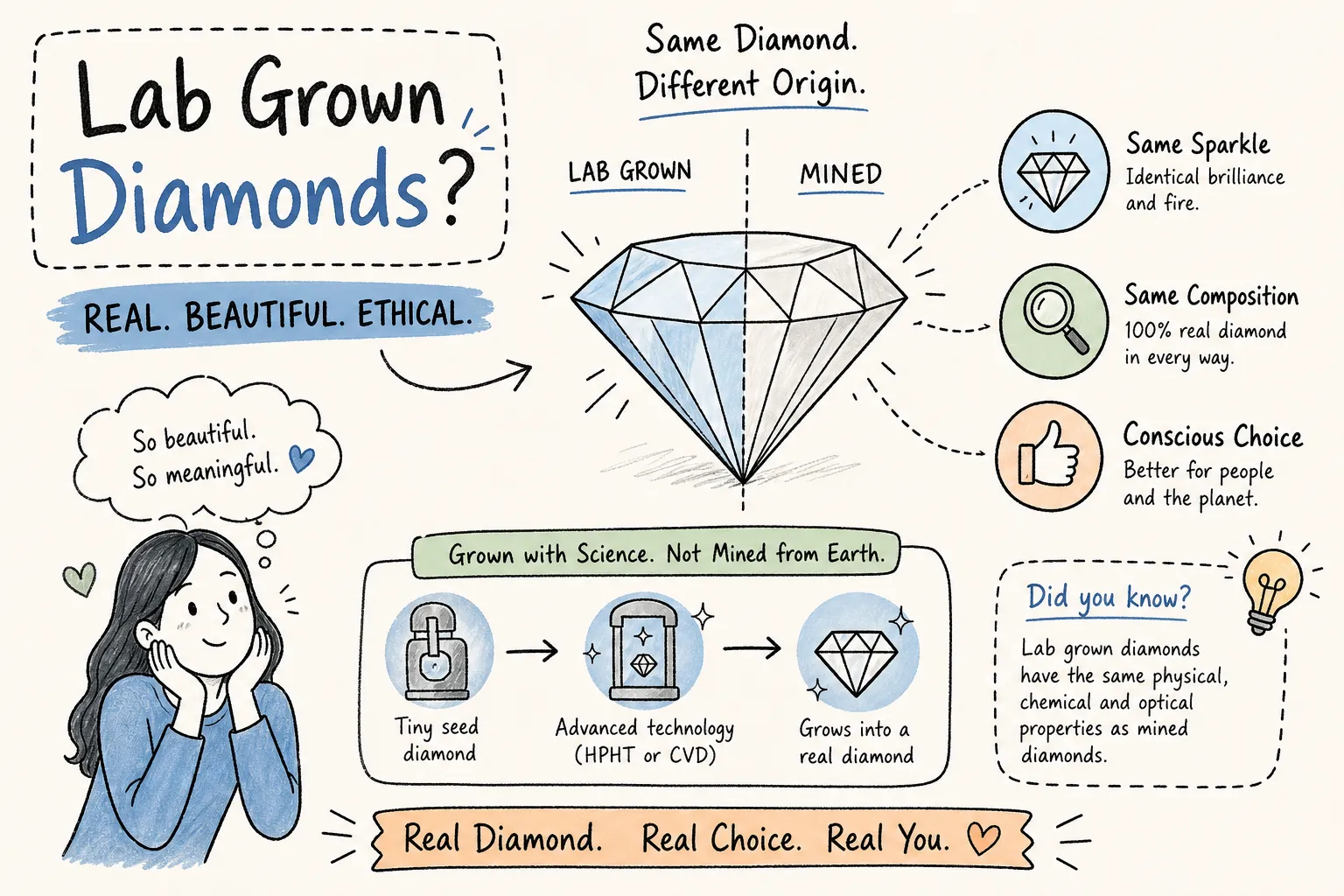
Yes, lab-grown diamonds are real diamonds. That's the short answer, and it's worth stating clearly before anything else. They share the same chemical composition, the same crystal structure, and the same physical and optical properties as mined stones. Even under standard magnification, a gemologist cannot distinguish them from mined diamonds by sight alone, specialized laboratory equipment is required to tell the difference. The only thing that differs is where and how they formed.
The confusion is understandable. Terms like "synthetic" or "man-made" carry a connotation of fake or inferior. Gemological organizations generally prefer "lab-grown" or "laboratory-grown" because those terms more accurately describe origin without implying a difference in material. Lab-grown diamonds are not cubic zirconia. They are not moissanite. They are carbon atoms arranged in the exact same crystalline lattice as a diamond pulled from the ground.
This article covers how lab-grown diamonds are made, how they grade by the 4Cs, what realistic prices look like in 2026, the honest sustainability and resale picture, and what to verify before you buy.
How Lab-Grown Diamonds Are Made: HPHT and CVD
Two production methods are in mainstream use today. High Pressure High Temperature (HPHT) recreates the extreme conditions found deep inside the Earth, applying roughly 5, 6 gigapascals of pressure and temperatures between 1,300 and 1,600 degrees Celsius to crystallize carbon around a diamond seed. Chemical Vapor Deposition (CVD) works differently: a carbon-rich gas is converted into plasma inside a sealed chamber, and the diamond grows layer by layer onto a seed crystal at much lower pressure. Both methods produce genuine diamond crystal structure. CVD is widely used in retail production and is commonly favored for larger, high-clarity stones.
Neither method produces an inferior stone. At equivalent 4Cs grades, a well-cut HPHT diamond and a well-cut CVD diamond are visually indistinguishable. Grading labs like IGI note the growth method on the report, that's a transparency feature, not a red flag. When you see "CVD" on a certificate, it tells you exactly what you're getting. That's a good thing.
Quality and the 4Cs: Grading Works the Same Way
Lab-grown diamonds are graded on cut, color, clarity, and carat weight using the same criteria applied to mined stones. IGI (International Gemological Institute) is the most widely used certification for lab-grown diamonds and issues individual grades for each of the 4Cs. Since October 2025, GIA shifted its standard lab-grown grading to a broader "Premium" or "Standard" assessment rather than publishing individual color and clarity grades. That change makes side-by-side comparisons harder. For most buyers evaluating multiple stones, an IGI report is the cleaner, more practical tool.
The smartest buying strategy is to prioritize cut quality and eye-clean clarity over chasing the highest color grade. A G-H color, VS2-SI1 clarity stone with an excellent cut is typically indistinguishable from a D-F stone to the naked eye, and it costs meaningfully less. This is where lab-grown diamonds give buyers a genuine advantage: the quality-to-budget equation tilts heavily in your favor when you stop paying for grades that don't register visually.
Price: What to Realistically Expect in 2026
For loose, IGI-certified stones at U.S. retail, here are current planning benchmarks by quality tier:
Value option: 1 carat, G-H color, VS2-SI1 clarity, very good or excellent cut, approximately $500, $1,000
Popular sweet spot: 1 carat, G-H color, VS1-VS2 clarity, excellent cut, approximately $700, $1,500
Premium option: 1 carat, D-F color, VVS clarity, excellent cut, approximately $1,000, $1,800 and up
Large stone: 2 carats, G-H color, VS clarity, commonly $1,800, $3,500
Lab-grown diamond prices have trended downward as production scales, which means buyers today get significantly more stone for the same budget than they would have three or four years ago. That trend is good news at the point of purchase, though it does affect resale, which the next section addresses directly.
Finding the best value isn't about locating the cheapest listing. It's about buying an IGI-certified stone with strong proportions, verified against a grading report, from a retailer with a solid return policy. Uncertified stones at bargain prices aren't bargains; they're liabilities. Buyer-protection research consistently points to certificate verification and clear return policies as the two most important safeguards for diamond purchases.
Sustainability and Resale: The Honest Picture
Lab-grown diamonds require no mining, which eliminates the land disruption, habitat loss, and supply-chain concerns tied to mined diamond production. For shoppers who care about where their purchase comes from, that's a meaningful advantage. When lab-grown diamonds come paired with IGI certification, the buyer gains a documented trail from growth to grading, in many cases offering stronger traceability than mined stones can provide, particularly where supply-chain documentation is limited.
On carbon footprint, the picture is more nuanced. A lab facility powered by renewable energy can produce diamonds with a fraction of the emissions associated with mining. A facility running on fossil-fuel-heavy electricity can actually exceed mining's carbon output. The claim that lab-grown is universally greener doesn't hold up across the board, if this matters to you, ask the retailer or producer directly about their energy source before deciding.
Resale is where buyers need a clear-eyed view. Lab-grown diamonds generally resell at around 10, 40% of the original retail price. Mined diamonds tend to retain more value, typically at 25, 60% of retail, but they also cost far more upfront. Neither category is a reliable financial investment. Fine jewelry is a purchase for meaning, beauty, and occasion, not a portfolio strategy. If maximum size and quality for the budget, along with ethical sourcing, are the priorities, lab-grown is the straightforward choice. If natural origin and comparatively stronger resale prospects matter more, mined makes sense. Both answers are valid.
How to Buy Lab-Grown Diamonds With Confidence
Before committing to any purchase, work through this checklist:
Confirm the grading report comes from IGI, GIA, or GCAL
Verify the report number matches the laser inscription on the stone's girdle under magnification
Check that the return window is at least 30 days, with insured return shipping included
Confirm shipping insurance covers the full purchase value, including loss and damage in transit
Get warranty terms in writing before you pay, not after
For high-value purchases, have an independent gemologist inspect the stone while the return period is still open
Finding the right retailer matters as much as finding the right stone. At Vallcha Jewelry, you'll find IGI-certified lab-grown diamonds set in curated 14K and 18K gold designs, with both an online shopping experience and an NYC showroom for buyers who want to see the stones in person before committing. The bespoke design service means you're not limited to what's already in the case, a custom piece built around your specifications is entirely within reach.
The Bottom Line on Lab-Grown Diamonds
The evidence on lab-grown diamonds is straightforward once you look past the terminology. They are certified, graded by the same standards as mined stones, and visually identical in every practical sense. The decision between lab-grown and mined comes down to your priorities, not quality. If size, ethical sourcing, and value are what matter most, lab-grown diamonds are a compelling choice. Start with an IGI-certified stone, prioritize cut above all other grades, and buy from a retailer with a clear return policy and verified customer reviews.
If you're ready to see what a certified lab-grown diamond looks like in a beautifully crafted gold setting, explore the collection at Vallcha Jewelry or book a consultation at the NYC showroom. Seeing the stones in person, under real light, answers most remaining questions faster than any article can.
